THE BOOKS I READ IN 2025
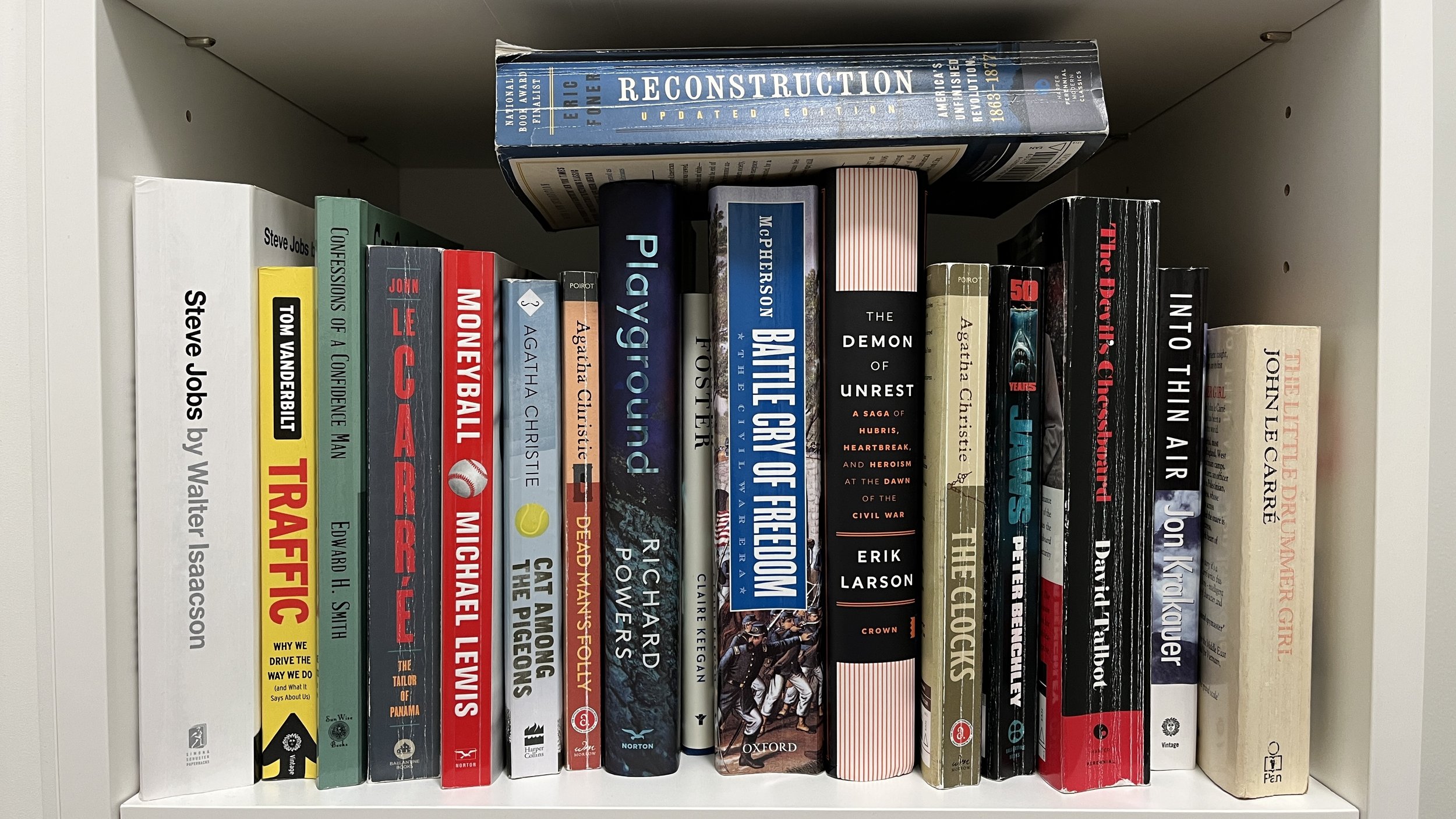
In the order I finished them (not started them) from left to right and top.
I like the Aaron Sorkin / Danny Boyle movie Steve Jobs - it’s one of those movies I can put on some random Tuesday and just watch it. Good performances, nice dialogue, inventive filmmaking, and structurally the film is interesting. Everyone talks about dialogue when they talk about Aaron Sorkin, but I think what actually makes him good is his structure. Anyone can write funny, witty, dialogue, but the structure is the context in which it sits and is the difference maker. If more film writers were better at structure, the world would be a more interesting place - cinematically speaking.
In this movie, the film is broken in to three time periods, each roughly the same length before three big product launches of Apple Computer products covering over thirty years. Each section comprises of five, two person scenes - always with Steve Jobs as one of the players. So, in the first beat there’s a scene with Jobs and Wozniak, and then you see them ten years later, and ten years later. There’s a lot that happens off screen and that all informs how this conversation is going to. It’s all very clever and interesting and funny and I’ve seen the film so many times, I finally was like - how real is this movie? And it says it’s based on this book, so that’s how we ended up here.
The movie appears to be mostly made up - none of what happens in the movie is in the book. But, that’s fine. Isaacson is a very very very good writer (I like using very three times when talking about how good a writer is because a good writer would never do that), and Jobs is fascinating and really weird. The movie does capture that energy and the broad strokes of the issues that defined him and this time period. You get the vibe, the taste, and the feel, but the interpersonal stuff seems to be created for dramatic effect. I think the simplest take away from the Steve Jobs biography book was that you did not want to be on his bad side. He was resourced and motivated, and if you crossed him, he would demolish you or make the iPod.In my continuing fascination with our built world, this book explores the causes of and potential fixes for a problem that I think everyone in the world could agree upon is teh worst - traffic. Traffic is so interesting because it is actually the one thing that no one likes - there’s literally zero people who would argue in favor of traffic - and yet we are unable or unwilling to do anything about it. Traffic, in it’s simplest form, means movement - through a system, roads, or of goods. But, if I said the word traffic, the first thing you’d think about would not be movement but blockage. One of the interesting ironies of traffic.
Traffic is not a thing unto itself, it is created by other things - where the jobs are relative to where the people who do those jobs live is a big one. A prime example of this is Istanbul, Türkiye. The European Side is “the rich side,” and where all of the good paying jobs are, restaurants, hotels, etc. and so it’s expensive to live there. The Asian Side is where everyone who works on the European side lives because that’s where they can afford to live. Separating the European and Asian sides is the Bosphorus Straight with three - count ‘em three - ways to cross (two bridges and tunnel - oh also car ferries). So, you take all the people who live on one side and then make them all go to work on the other side at the same time and what do you get? Traffic. It’s maddening. But how do you solve a problem that no one really created? It’s a classic tragedy of the commons situation.
Traffic is interesting because it seems like an issue that is independent to other issues - build more roads, congestion tax, more buses, more cars, etc. - but it’s deeply ingrained into how we’ve built our world and so fixing traffic is probably… not going to happen?Confessions of a Confidence Man: A Handbook for Suckers - Edward H. Smith
A memoir by an actual confidence man, this book is so excellent and it’s available for free as a pdf online. Read it now! Edward H. Smith had a successful career as a con man and then penned a confession - a guide - on all of the different cons that exist - The Talking Typewriter, The Wonderful Window Closer, The Gold Brick Modernized and more. It’s comprehensive and exhaustive and peppered with tons of great stories from the field. If you like con artist stories, this is a great read and might give you a few ideas on your next con!
I will not tell you what my favorite con is from the book, because I am writing a film from that and I don’t want you stealing my idea.The Tailor of Panama - John LeCarré
Talk about con artists! This book from 1996 that was also made into a 2001 movie with a just-about-to-be-post-James Bond Pierce Brosnan and Geoffrey Rush (as the eponymous tailor) is about two gentlemen, each corrupt in their own way, that basically start a war. It’s a very readable LeCarré, who I think sometimes can be so cloaked in mystery and intrigue so as to be obtuse. This is classic story of a ‘in for a penny, in for a pound,’ and all of the horrible ramifications that snowball from a small little lie.
Moneyball: The Art of Winning an Unfair Game - Michael Lewis
Another movie I love to watch written by Aaron Sorkin (like Steve Jobs above) and I was like - how true to the book is this? Again, not at all. I mean… the Oakland Athletics are the same in the book and the movie but that’s about it? Again, though, the film captures the idea, the energy, and the broad concepts of what ‘moneyball’ is all about. I’m definitely late to the game (pun alert) on this one as this book came out years ago and has since revolutionized not only baseball but all sports… everywhere?
Cat Among The Pigeons - Agatha Christie
Did a lot of Poirot this year - almost done with all of them. That being said, they’re all fairly similar and so no review of them will happen because looking back, I don’t think I could differentiate one from the other.
Dead Man’s Folly - Agatha Christie
Another Poirot book!
Written by a Chicago (Evanston) writer, it tells the story of a trio of friends in a dystopian-ish future (ish because it’s a dystopian future that looks pretty much like right now - earth burning, tech companies making millions, culture wars doing their thing. I didn’t know what to expect when I started reading this. I was interested in it because he’s local and it was getting buzz and I enjoyed it, even though it’s not something I would normally reach for.
The biggest thing I remember when as I write about this book was that I was on a plane this summer and the guy sitting across the aisle from me was reading this book. I saw that he was reading it and I thought to myself, I could start up a conversation with this guy about how he’s liking the book as I had just finished it. I like the idea of being the type of person who would strike up a conversation with a stranger about a book that we’ve both read, but I also like the idea of being the type of person who doesn’t do that. I mean, what would the conversation have been?
Jack - How you liking your book?
Guy - Excuse me?
Jack - That book - Playground. I read that book. Just finished it. How are you liking it?
Guy - I don’t know yet, I’m only half way through.
Jack - Cool. Enjoy it!
Guy - Yep.
And then a six hour flight where each time we make eye contact it’s like is someone going to talk about the book? What is this relationship based on?
So, I decided not to say anything to him.Rebecca’s Mom, Marianne Fons, bought me this book out of nowhere because we were talking about movie adaptations and this had been made into The Quiet Girl a few years prior. She said it was great and did the thing that mothers-in-law do, which is just surprise you with a book. This is a wonderful book and it takes a bout two hours to read so you have no excuse to not read it. This is what anyone who writes I feel like is aspiring towards in terms of economy, impact, insight, and empathy. Movie is also pretty good - but the book is better!
Battle Cry of Freedom: The Civil War Era - James M. McPherson
This is the book of the year for me and it captured me in the preface. Both sides in this fight professed to be fighting for freedom - the South for state sovereignty, the North for liberty. He then presents the song ‘The Battle Cry of Freedom’ written by a Northerner George F. Root in 1862. The tune was so catchy that one of the South’s leading composers, H.L. Schreiner and lyricist W.H. Barnes adapted it for the South.
Here’s a telling example of the difference:
Union: “…and although he may be poor, not a many shall be a slave, shouting the battle cry of freedom…”
Confederates: “…Their moto is resistance, to tyrants we’ll not yield, shouting the battle cry of freedom…”
I can’t think of a more compelling way to think about how different sides see America than we are singing the same song but different lyrics.The Demon of Unrest - Erik Larson
I got this before Battle Cry, but finished it after only because I picked up Battle Cry and was so enamored with it that I raced through it. Demon of Unrest is about the time immediately before the Civil War and the shambolic way we collectively stumbled into setting ourselves on fire. Erik Larson seems to turn out two books a year on various history subjects - and he’s good. Very readable and he gives you good entry points into the stories he’s trying to tell. This book is notable because Abraham Lincoln plays a supporting role (at best - he’s barely in it), instead, this book focuses attention on everyone else - the lesser players of history, who shaped history, most notably Major Robert Anderson who led the garrison at Fort Sumter (that’s where the Civil War starts for those who are not initiated).
Another Poirot book!
Jaws is one of Rebecca’s favorite films - as she put it last year, “Happy 50th anniversary to JAWS, one of my favorite movies and a perfect film about masculinity, capitalism, fear, and a big f*cking shark - in that order.” The book is great and is quite different from the movie in a number of important ways! I almost think that the movie and the book are not really the same thing. Like the book The Shining and the Kubrick movie The Shining, although one is based on the other, the changes made by Kubrick make it a completely different ‘thing.’ That’s true here too - the book, Jaws, and the movie, Jaws, although share a lot of the same DNA are completely different in what they’re trying to explore in masculinity, capitalism, and fear - and what they’re trying to say about these things.
If you’re interested but haven’t read Jaws because you saw the movie, I would give it a go because seeing the movie doesn’t really matter in this case.The Devil’s Chessboard - David Talbot
A friend (and lover of books), Caroline Garske, knowing that I also loved books recommended this to me - a history of the CIA with special focus on it’s first civilian director, Allen Dulles. This dude was bad news. Cheated on his wife constantly - according to his sister, Eleanor, Dulles had "at least a hundred" extramarital affairs, he was friends with Nazis and tried to get some of them out in the middle of World War 2. Most striking was he had his family members tested on in the MKUltra program to try to “help” them. Craziness! He’s legitimately like the bad guy that seems to show up in these superhero movies. Smart, cunning, and ruthless, nothing can stop him in his quest to defeat the commies and also amass personal wealth and power. He seems to have no clear morality guiding his actions, that being said there seems to be a very cleaer thing driving his actions - a belief in the greatness of American capitalism and all that she gives - here’s the CIA’s review of the book.
This book is Krakauer’s “Personal Account of the Mt. Everest Disaster” - the 1996 climbing accident that led to the death of eight climbers while trying to climb Everest. It’s harrowing AF. Before things start going wrong, it’s an absolute nightmare - the way he lays out what happens to your body when you enter into ‘the death zone’ (what do you think happens?) would make me never want to climb it. One story is I think on their hike to base camp - so before you’ve actually started - they stayed at a lodge that was heated by an open coal fire and he got sick and had to sleep outside in the cold just to breathe. He was awoken in the middle of the night by one of the other climbers who had some gastro-intestinal issue and was just shitting in the middle of the street. They haven’t even started the climb at this point!?
When things go wrong though, is when this story becomes truly awful. The ironies, the just-misses, the small decisions that lead to big consequences, they all loom large. Even if you know that some folks die on Everest, you will never guess who exactly will and the power of the human spirit to endure at the edge of what’s possible is incredible.The Little Drummer Girl - Jon LeCarré
A great pitch - an actress with revolutionary ideals gets recruited to fight against the revolution using her prowess in the theater as her only training. I won’t say anything more. Read it.
Reconstruction: America’s Unfinished Revolution, 1863 - 1877 - Eric Foner
How did we get it fairly right for a period of time after the Civil War and then get it so wrong? Why did that happen? Why is Reconstruction as a period in American history so mis- (or even under) understood. Reconstruction is the period immediately after (although as the title suggests, Eric Foner believes that it started mid-Civil War) that worked to redress the inequalities of slavery in the eleven states that ceded from the Union following the election of Abraham Lincoln as President. It led to a period of intense federal intervention at the state level, the rise of the KKK, the phenomenon of ‘carpetbaggers,’ Northerners who, because they were richer, came South to buy up cheap land and try to make some money and press their values on the local population. It also saw real progress like former slaves being elected to state and federal offices with the expansion of the franchise as well as getting into business and building wealth. It’s this moment of time in America where it seemed almost possible that we could live up to the ideals of what this country was founded on.
But, what were the ideals this country was founded on? That’s where this idea of the ‘unfinished revolution’ comes in. Like in Battle Cry and Demon of Unrest this book expands on the idea that the Civil War was a fight for what America was. The Southern slave-holding states believed they carried the mantle of what America was - agrarian, slave-holding, small government and that the newly industrialized North was something new and starting to not look like the America they knew anymore. Sound familiar?
It should, because our failure to reconstruct our country after the Civil War has led to a lot of the ills of the 20th and 21 centuries that still plague our nation. In learning about this fleeting moment it’s good to see where we went wrong - which is where we always seem to go wrong; poor leadership, greed, laziness, and white supremacy.